
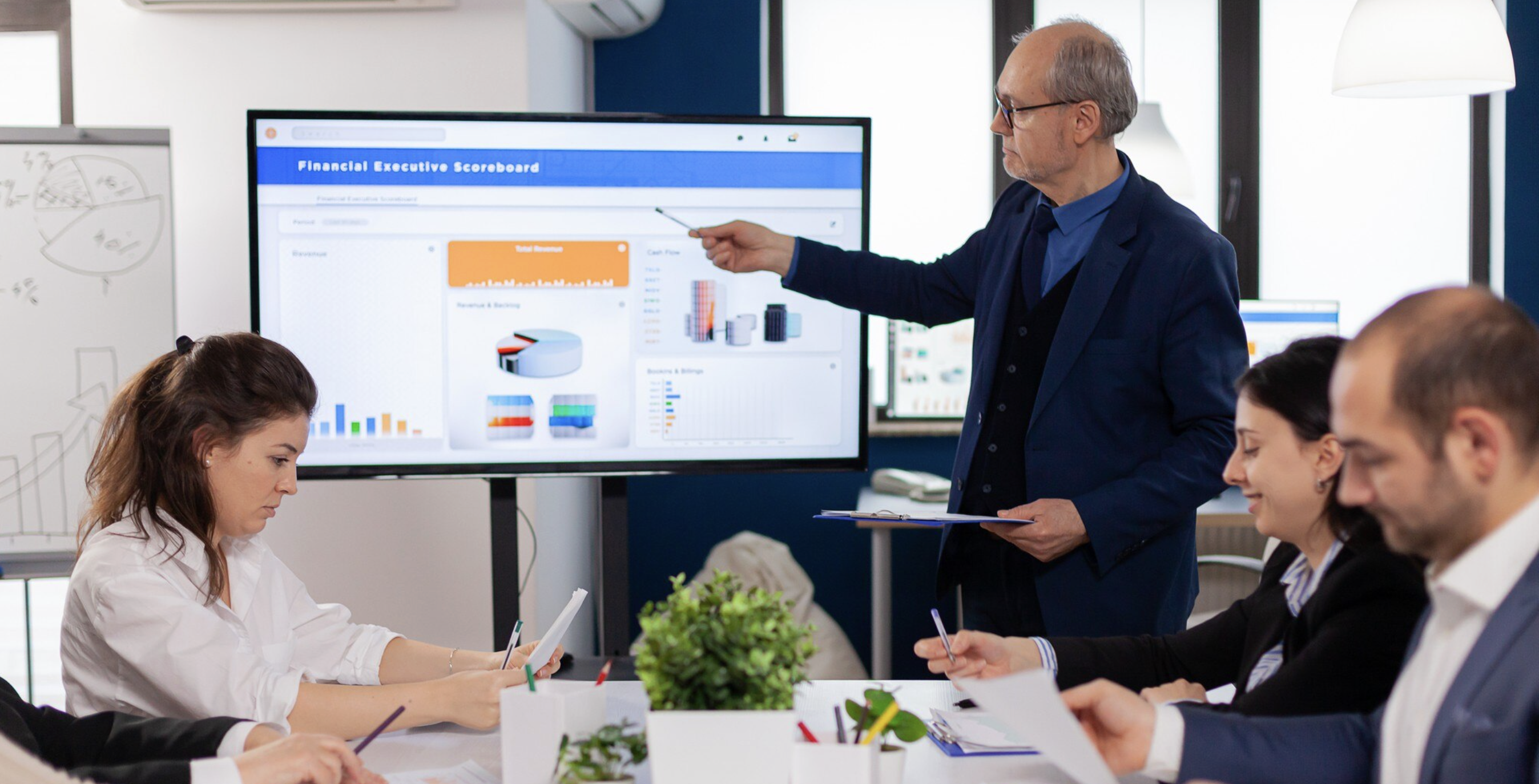
Why Traditional Presentations No Longer Work
For decades, presentations followed a predictable format: one person talks while others listen, slides display bullet points, and questions wait until the end. This approach worked well enough when it was the only option, when audiences had fewer distractions, and when the presenter held all the information.
Those conditions no longer exist.
Today's audiences have smartphones in their pockets, competing content a tap away, and access to more information than any presenter could deliver. The traditional presentation model, built for a different era, is failing to engage modern audiences.
Here's what changed and what works now.
What changed
Attention is now a scarce resource
The average adult encounters thousands of messages daily: emails, notifications, social media, news alerts. Our brains have adapted by becoming more selective about what receives focused attention.
Research shows that attention during passive content drops significantly after 10-15 minutes. This isn't a character flaw; it's an adaptation to information abundance. When audiences have trained their brains to scan and filter, traditional presentations that demand 45 minutes of passive listening are fighting biology.
Information is no longer scarce
Traditional presentations positioned the speaker as the source of valuable information that audiences couldn't easily access elsewhere. This created inherent value in listening.
Now, any fact in your presentation can be verified, expanded, or contradicted with a quick search. Audiences arrive having already researched topics. They don't need you to read information they could find themselves; they need insight, perspective, and experiences they can't get from articles.
Audiences expect participation
Social media, interactive content, and on-demand entertainment have trained people to expect input into their experiences. Passive consumption feels increasingly unnatural.
When people spend their days liking, commenting, sharing, and choosing what to watch next, sitting silently while someone talks at them feels like a step backward. The question isn't whether they'll engage with something during your presentation; it's whether they'll engage with you or their phones.
Remote and hybrid changed everything
The shift to remote and hybrid work exposed how broken traditional presentations were all along. When audiences are on video calls, the competition for their attention intensifies. They have email in another tab, messages pinging, and no social pressure to appear attentive.
Presentations that barely held attention in meeting rooms completely lose it on screens. Remote work didn't create the engagement problem; it revealed how severe it already was.
Younger generations have different expectations
People who grew up with interactive technology don't consider passive consumption the default. They expect to participate, not just observe. They're used to content that responds to them.
As these generations become larger portions of the workforce and audience base, expectations shift. What older generations tolerated seems unnecessarily passive to those who've always had interactive options.
Why traditional presentations fail
Understanding what changed reveals why the traditional model fails:
One-way communication ignores the audience
Traditional presentations treat audiences as receivers, not participants. But learning and engagement happen through processing, not passive receipt. When you don't give audiences something to do with information, they often do nothing with it.
Slide decks become scripts
When presentations center on slides, presenters often read them. When presenters read, audiences disengage. Why listen to someone read what you can read faster yourself?
Slides were meant to support speakers, not replace them. But the traditional model has inverted this, with presenters serving their slides rather than slides serving the message.
Q&A at the end comes too late
Saving questions for the end means confusion compounds rather than getting addressed. Attendees who get lost early stay lost. By the time Q&A arrives, most have mentally checked out, and only the most vocal speak up.
No feedback means no adaptation
Traditional presentations are blind. The presenter has no insight into whether the audience understands, agrees, or cares. Without feedback, there's no adjustment. Confusion persists. Irrelevant sections continue. The presentation proceeds regardless of whether it's working.
The format rewards preparation over connection
Traditional presentation culture values polish, comprehensive content, and smooth delivery. These matter, but optimizing for them often means sacrificing connection. A perfectly delivered presentation that doesn't engage is still a failure.
What works now
Modern presenters who consistently engage audiences share common approaches:
Interaction throughout, not just at the end
Effective presentations include participation from the start. A poll in the first two minutes, comprehension checks after complex sections, discussion prompts between topics. This rhythm keeps audiences active rather than passive.
When people participate early, they commit mentally. They're part of the experience rather than observing it. This commitment sustains attention in ways passive listening cannot.
Audiences on their own devices
Instead of watching a distant screen, audiences follow along on their phones or laptops. They see the same content the presenter sees, interact through their own devices, and contribute without raising hands.
This approach levels the playing field between in-room and remote attendees, captures responses from everyone simultaneously, and creates documented engagement rather than guessed reception.
Real-time feedback informs delivery
When you can see that 60% of the room understood a concept but 40% didn't, you know to spend more time on it. When poll results surprise you, you adapt on the spot. This feedback loop transforms presentations from performance into dialogue.
The presenter still leads, but the audience shapes the experience. This collaboration creates relevance that scripted presentations cannot achieve.
Stories and specifics replace bullet points
Modern audiences don't need you to list facts; they need you to make meaning. Stories create emotional connection. Specific examples illustrate abstract points. Personal experiences build trust.
The shift from information delivery to meaning creation changes what a presentation even is. It's not a transfer of data; it's a shared exploration of ideas.
Less content, more depth
Traditional presentations often try to cover everything. Modern presenters recognize that covering less thoroughly beats covering more superficially.
If audiences remember one idea and apply it, that's success. If they heard ten ideas and forgot them all, that's failure. Depth beats breadth.
Visual communication over text-heavy slides
Slides filled with bullet points duplicate what the presenter says, splitting audience attention. Effective visual design uses images, diagrams, and minimal text to complement spoken words rather than compete with them.
When slides enhance rather than duplicate, audiences can focus on the presenter while visuals add context.
The shift from presenting to facilitating
The fundamental change is a shift in role. Traditional presenters are performers delivering content to passive audiences. Modern presenters are facilitators creating experiences with active participants.
This shift requires different skills:
Listening alongside speaking: When audiences respond in real-time, you need to process their input and adapt. Facilitation requires flexibility that scripted performance doesn't.
Designing for participation: Interactive elements don't happen spontaneously. They require intentional design, testing, and refinement. Every participation moment needs a purpose and a place in the flow.
Comfort with uncertainty: When you invite participation, you don't know exactly what will happen. Results might surprise you. Discussions might go sideways. This uncertainty is a feature, not a bug; it's where genuine connection happens.
Technology fluency: Interactive presentations require tools that work smoothly. Fumbling with technology undermines the engagement you're trying to create.
Objections and responses
"My content is too complex for interaction"
Complex content benefits most from interaction. Comprehension checks reveal misunderstanding immediately. Discussions surface questions that would otherwise go unasked. Breaking complex material with activities aids processing.
If anything, complexity demands more interaction, not less.
"I don't have time to make it interactive"
Interactive elements don't require more time; they require different time allocation. Replace some content slides with participation moments. The same total time, used differently.
Often, interactive presentations actually cover more effectively because they address confusion immediately rather than leaving it to compound.
"My audience won't participate"
Participation is a design challenge, not an audience characteristic. If you ask questions that feel safe, provide anonymous response options, and acknowledge contributions meaningfully, people participate.
Audiences that "won't participate" usually haven't been given compelling opportunities to do so.
"Traditional presentations work fine for me"
Do they? How do you know? Without feedback mechanisms, you can't see the disengagement, confusion, or distraction you're missing.
What feels like working may simply be an absence of visible failure. That's not the same as success.
The way forward
The transition from traditional to interactive presenting isn't about discarding everything you know. It's about evolving your approach to match how audiences now process information.
Start small:
- Add one poll to your next presentation
- Check comprehension after your most complex section
- Ask for input before revealing your recommendation
- Close with a question that prompts reflection
Notice what changes. Audiences will be more alert. Discussions will be richer. Retention will improve.
The traditional presentation isn't dying because it never worked. It's dying because what worked in a world of limited information and few distractions no longer works in a world of infinite content and constant competition for attention.
Audiences have changed. Presentations must change with them.
Ready to make the shift?
Try Sync free and transform your presentations from one-way delivery to two-way dialogue. No credit card required.
Want to learn how to build interactive presentations? Check out our complete guide to interactive presentations.